Reference Architecture
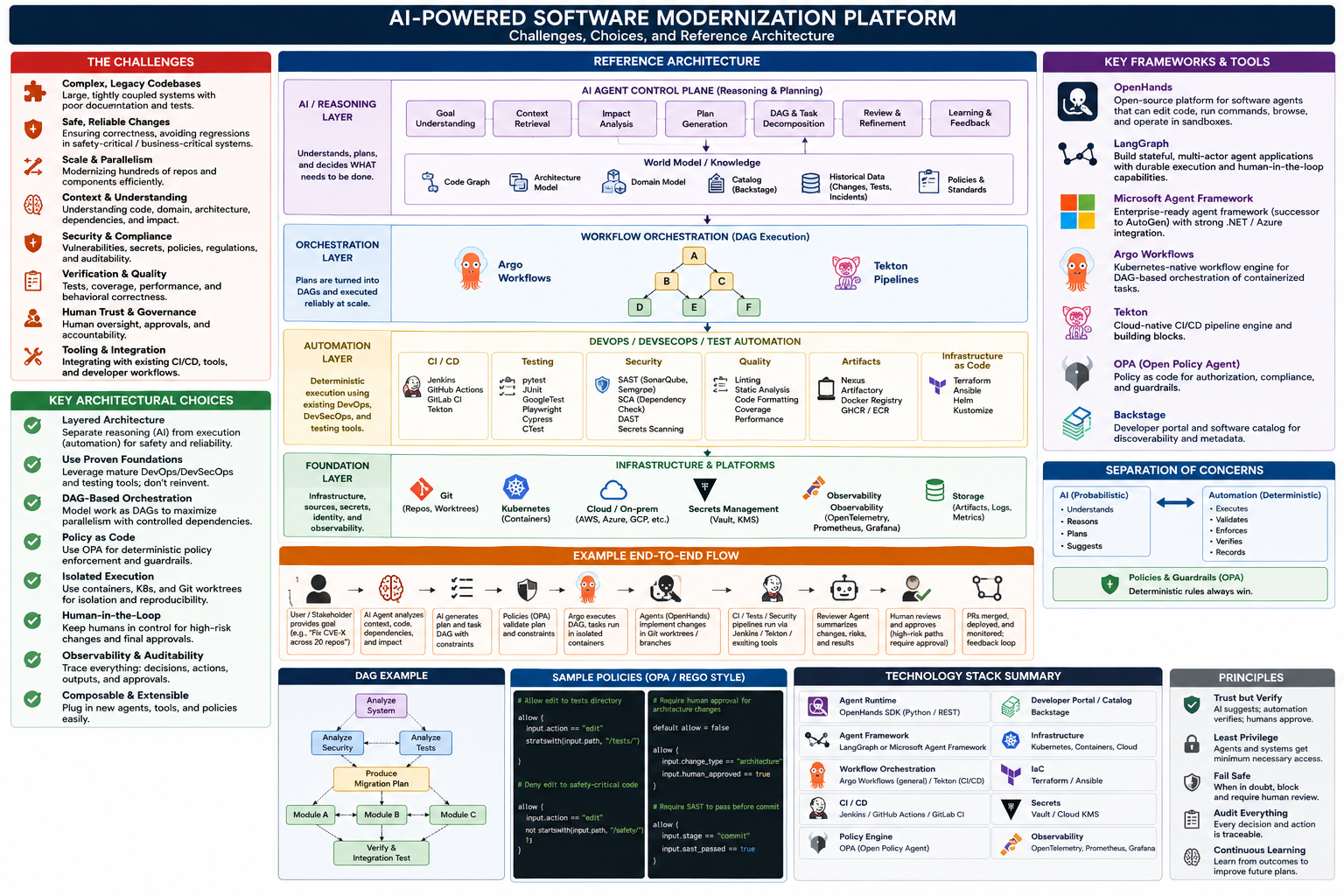
The platform on one page. Select the image to open it at full size.
Reading the infographic against this site's vocabulary
- The top band, labelled AI agent control plane, is what this site calls the reasoning layer. Here, control plane always means the deterministic layer that enforces policy, leases and budgets — see Vocabulary.
- Its end-to-end flow ends at "PRs merged". On this site, merging always goes through the merge queue, validated against the latest base.
Foundations shows the coordination view: how work flows from intent through isolated execution into a single controlled gate. This page shows the complementary platform view — which layers the system is built from, which of them are new, and which you should reuse.
Layers
Your architecture should survive replacing the agent framework. Something like:
Read it as alternating layers. The planner and the agents reason: they propose plans and changes. Everything between and around them is deterministic: it decides whether a plan is allowed, schedules it, isolates it, verifies what comes out and gates what goes into trunk.
| Reasoning layer — probabilistic | Control plane and automation — deterministic |
|---|---|
| Understands | Executes |
| Reasons | Validates |
| Plans | Enforces |
| Suggests | Verifies and records |
When the two disagree, the deterministic side wins. That is the whole design in one sentence — developed in Engineering Agents.
What is new, and what isn't
Most of this architecture is not new at all:
| Problem | Largely solved by |
|---|---|
| Execution | Twenty years of DevOps |
| Distributed orchestration | Ten years of cloud-native infrastructure |
| Policy and gating | DevSecOps and policy as code |
| The verification loop | CI |
| Transactions and change history | Git |
| Repeatable, isolated execution | Containers |
| Turning a goal into a trustworthy task graph | Nothing yet — this is the new layer |
So I wouldn't start by building a generic agent framework. I'd prototype a thin reasoning layer over these existing systems, governed by a deterministic control plane — and spend the engineering effort on the one row that is actually new. The reuse side is covered in Building on the Mature Stack.
One flow, end to end
A goal such as "Remove vulnerability CVE-X across these 20 repositories" moves through the layers like this:
That architecture has a much stronger engineering pedigree than an autonomous swarm of LLM agents talking to one another. Three of its eleven steps involve a model; none of the steps that decide what reaches trunk do.
Where the real research problem is
The genuinely new problem isn't DevOps, execution, scheduling or even testing. It's how the reasoning layer turns a high-level modernization objective into a trustworthy task graph, understands the software and its domain well enough to execute it, and learns from what it discovers. The rest can lean heavily on technologies that already have serious operational histories.